
Rockets, Mars Habitats & Telescopes • Teens Level A2-B1
Praise rocket launch telemetry, reward Mars rover geochemical discoveries, and certify Space Explorers!
Open Phase 1: Lexicon Decks. Play native audio for the 6 concept decks. Have students repeat in chorus and individual pairs to master technical phonetics.
Switch to Phase 2: Simulator. Guide learners through the 3 interactive challenges. Ask checking questions: "What happens if we adjust this parameter?"
Assign partner roles in Phase 3: Spoken Dialogues. Students practice the 5 scenario frames, alternating speaker and responder roles in fluent English.
Debate Phase 4: Ethics Dilemmas. Then guide all students to Phase 5: Star Award, click the certificate button, and celebrate with confetti!
| Student ID | Explorer Name | Role | Current Phase | Score | Stars | Station Status |
|---|---|---|---|---|---|---|
| Loading explorers on space station... | ||||||
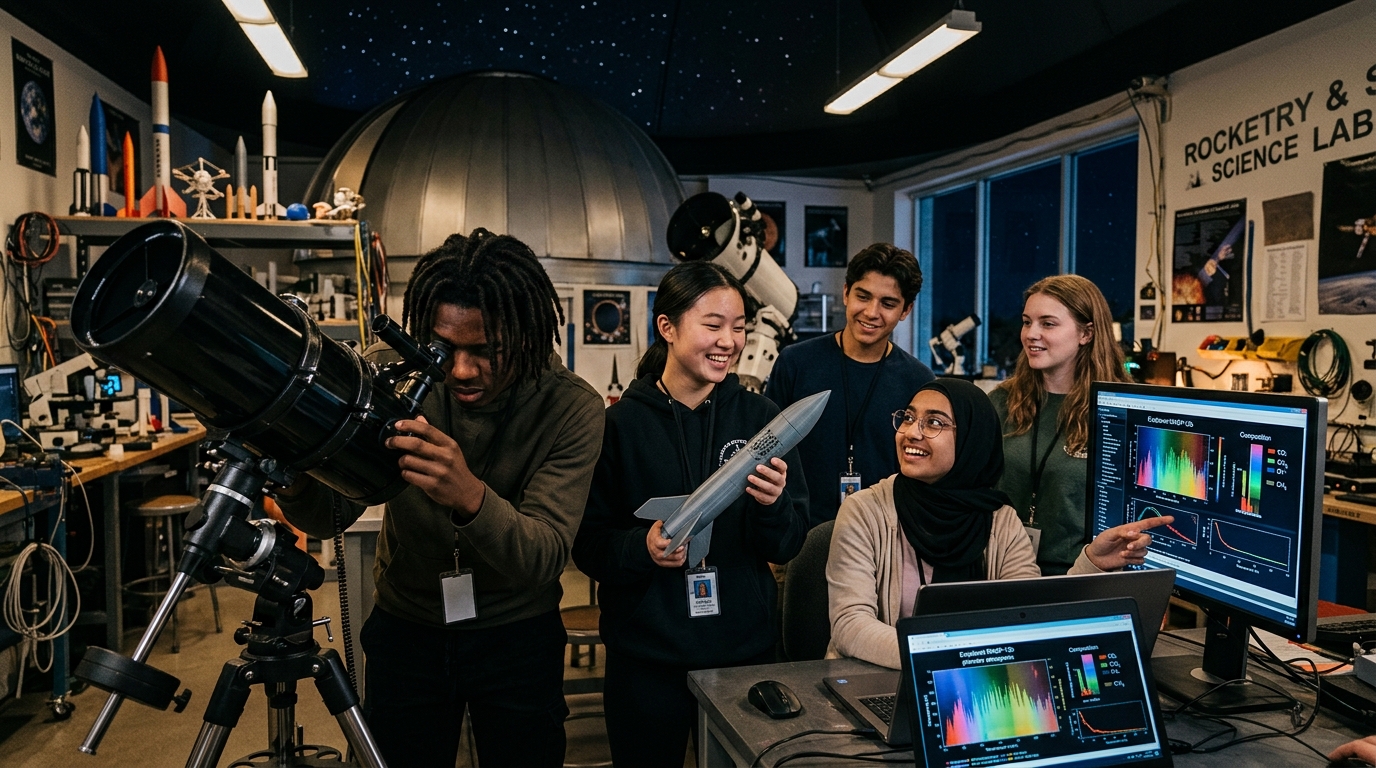
Execute rocket launch countdowns, analyze Mars rover geochemical samples, and discover habitable exoplanets in fluent English! Master orbital mechanics, zero-gravity physics, James Webb spectroscopy, and space law!
Click on the speaker icons to listen and practice English vocabulary for multi-stage rocketry, Mars colonisation, spectroscopy, and habitable exoplanets:
Telemetry Check • Main Engine Ignition • Booster Separation • Orbital Insertion
Practice speaking with Mission Control, analyzing Mars geology with lab partners, and debating space missions in English:
"Commander: Houston, this is Orion Crew-1. Life support systems are nominal, cabin pressure is steady at one atmosphere, and all astronauts are go for launch!"
Flight Director: "Copy that, Orion Crew-1! Weather radar confirms clear skies. Automated countdown sequence initiated at T-minus sixty seconds!""Geologist: Look at the X-ray spectrometer readings from core sample number four. We have detected layered clay minerals and hydrated silica!"
Astrobiologist: "Incredible! That confirms liquid water flowed through this ancient river delta for millions of years, creating prime habitable conditions for microbial life!""Sarah: I am the largest volcano in our solar system, towering twenty-one kilometers above the Martian plains. What geological landmark am I?"
Leo: "That is Olympus Mons on Mars!""Student 1: Robotic rovers are far more cost-effective and do not risk human lives in deep space."
Student 2: "While robotics are vital, trained human geologists and biologists can make instantaneous scientific decisions and conduct complex field experiments in minutes!""All Explorers: We pledge to explore the cosmos for the benefit of all humanity, share scientific knowledge openly, protect planetary environments, and reach for the stars in English!"
Mission Commander: "Outstanding vision! You have earned your official Space Explorer & Junior Astronomer Star Certificate!"A rover detects possible subsurface liquid brine. Should engineers drive the unsterilized rover directly into the pool or observe from a sterilized distance?
A defunct satellite poses a risk of colliding with other orbital hardware. Should space agencies abandon it or deploy active de-orbiting harpoons?
A space telescope detects an atmospheric bio-signature on an exoplanet. Should the data be open-source to global universities or monetized privately?
Water ice is discovered in permanently shadowed craters at the Moon's South Pole. How do nations govern resource extraction ethically?
🎉 CONGRATULATIONS! You have mastered rocket staging countdowns, Mars rover geochemical analysis, deep space spectroscopy, and space law in English!