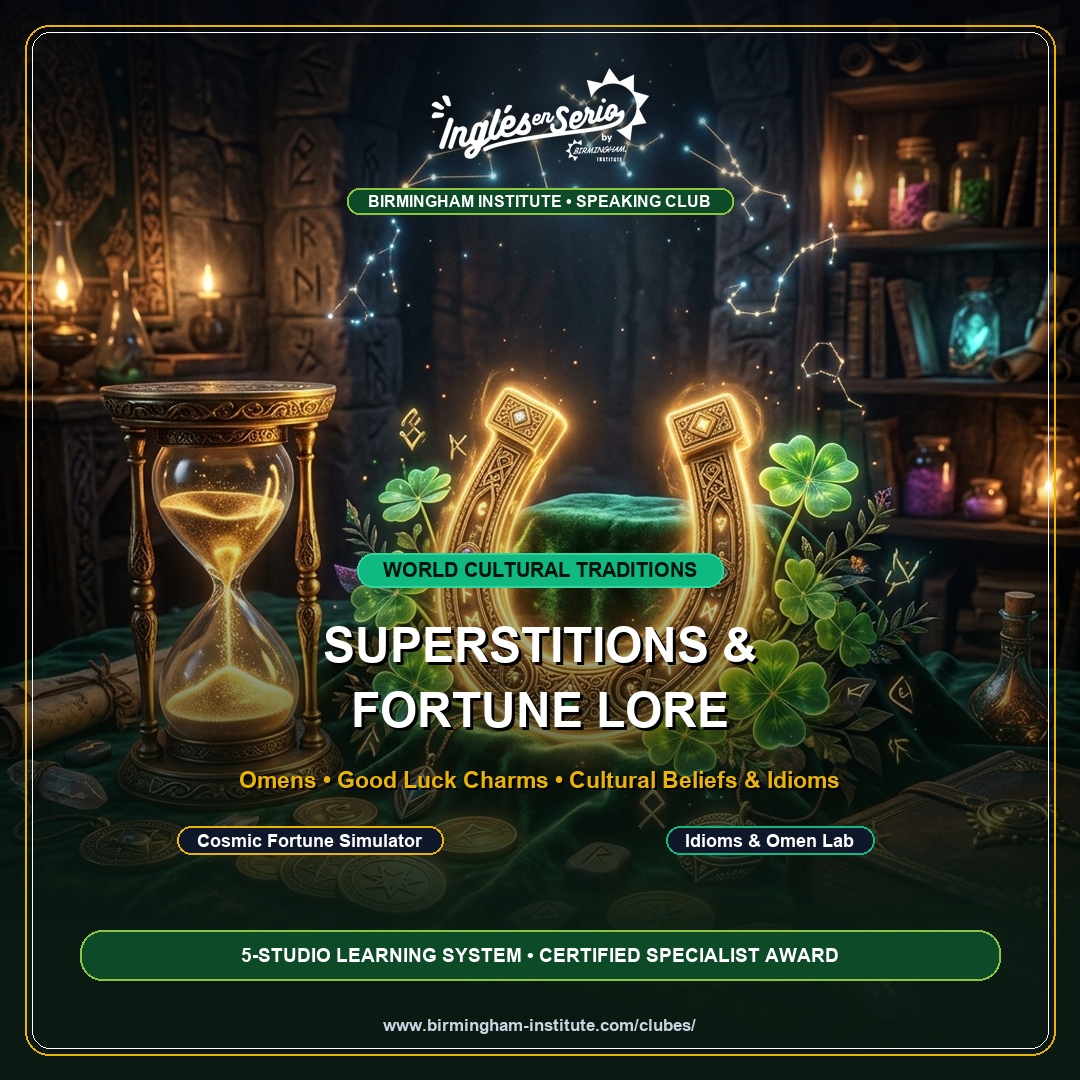
Studio 1: Luck & Omens Lexicon (30 Terms)
Master 30 key terms covering rituals, lucky talismans, astrology, tarot, and luck psychology.
Deck 1: Everyday Rituals & Taboos
Superstition
SupersticiónA belief or practice resulting from ignorance, fear of the unknown, or belief in magic/fate.
Knock on Wood / Touch Wood
Tocar madera (para evitar la mala suerte)A phrase said while touching wood to prevent bad luck after bragging or expressing hope.
Jinx
Dar mala suerte / Salar / GafeTo bring bad luck to a person, event, or team by declaring victory prematurely.
Omen (Good / Bad)
Presagio / AugurioAn event regarded as a portent or sign of good or evil things to come.
Triskaidekaphobia
Triscaidecafobia (miedo al número 13)Extreme or irrational fear of the number 13.
Deck 2: Lucky Charms & Talismans
Talisman
Talismán / Amuleto mágicoAn object inscribed with symbols thought to act as a charm to avert evil or bring fortune.
Amulet
Amuleto protectorAn ornament or small piece of jewelry thought to give protection against evil or danger.
Four-Leaf Clover
Trébol de cuatro hojasA rare variation of the common clover, traditionally considered to bring good luck.
Horseshoe
Herradura de la suerteA U-shaped iron plate nailed to a horse's hoof, hung above doors to collect good fortune.
Evil Eye (Nazar)
Ojo turco / Mal de ojoA glare, look, or charm believed to cause injury or bad luck for the person at whom it is directed.
Deck 3: Astrology & Celestial Fortune
Astrology
AstrologíaThe study of the movements and relative positions of celestial bodies interpreted as having an influence on human affairs.
Zodiac Sign
Signo zodiacalOne of the twelve 30-degree sectors of the ecliptic assigned to astrological personality traits.
Horoscope
HoróscopoA forecast of a person's future based on the relative positions of the stars and planets at the time of birth.
Celestial Alignment
Alineación celestialThe geometric positioning of planets and stars believed to influence cosmic energy.
Retrograde
Retrógrado (Mercury retrograde)The apparent backward movement of a planet through the sky, often associated with miscommunication.
Deck 4: Divination, Tarot & Palmistry
Divination
Adivinación / Arte adivinatorioThe practice of seeking knowledge of the future or the unknown by supernatural means.
Tarot Deck
Baraja de TarotA pack of 78 playing cards used from the mid-15th century for fortune telling and archetype study.
Palmistry (Chiromancy)
Quiromancia / Lectura de la manoThe art or practice of reading character or predicting the future from the lines on the palm of a person's hand.
Clairvoyance
ClarividenciaThe supposed faculty of perceiving things in the future or beyond normal sensory contact.
Archetype
Arquetipo (en cartas de tarot y mitos)A universal, recurrent symbol or pattern in human stories, psychology, and divination.
Deck 5: Psychology of Belief & Bias
Confirmation Bias
Sesgo de confirmaciónThe tendency to interpret new evidence as confirmation of one's existing beliefs while ignoring failures.
The Gambler's Fallacy
La falacia del apostadorThe mistaken belief that if a random event occurred frequently, it is less likely to happen in the future.
The Barnum Effect (Forer Effect)
El efecto Barnum (declaraciones genéricas creadas para sonar personales)The psychological phenomenon where individuals give high accuracy ratings to generic personality descriptions.
Illusion of Control
Ilusión de controlThe tendency for people to overestimate their ability to control random events through rituals.
Pseudoscience
PseudocienciaA collection of beliefs or practices mistakenly regarded as being based on scientific method.
Deck 6: Cultural Traditions & Global Lore
First-Footing
Primer visitante del Año Nuevo (tradición escocesa)The Scottish tradition of the first person crossing a threshold after midnight on New Year's Day to bring luck.
Tetraphobia
Tetrafobia (miedo o rechazo al número 4)Avoidance or fear of the number 4, common in East Asia because 4 sounds like "death".
Fortune Cookie
Galleta de la suerteA crisp, folded cookie containing a slip of paper with a fortune message or lucky numbers.
Gesundheit
¡Salud! (respuesta estornudo en alemán e inglés americano)Used to wish good health to someone who has just sneezed.
Serendipity
Serendipia (descubrimiento afortunado e inesperado)The occurrence and development of events by chance in a happy or beneficial way.
Studio 2: Interactive Fortune & Oracle Wheel Simulator
Spin the Interactive Oracle Wheel, decode daily fortunes, and test your superstition knowledge.
The Cosmic Fortune Oracle Wheel
Click "Spin The Oracle Wheel" to receive your fortune reading!
The Oracle Wheel will select a global superstition archetype and reveal its cultural lore.
Global Lore Trivia Challenge
Identify the correct cultural origin and meaning of global superstitions.
In East Asia, why is the number 4 (tetraphobia) avoided?
Studio 3: Spoken Comms & Real-World Dialogues
Practice conversational turns, idiom usage, and cultural discussions across 5 scenario scripts.
Dialogue 1: Discussing Lucky Charms Before a Major Pitch
Two colleagues talk about pre-presentation rituals and lucky items before entering the boardroom.
Dialogue 2: Spilled Salt & Broken Mirrors at a Restaurant
A diner accidentally knocks over a salt shaker and discusses household omens.
Dialogue 3: Horoscopes vs Astronomy Debate
Friends compare daily astrology readings with empirical science over coffee.
Dialogue 4: Fortune Telling & Palm Reading at the Fair
Two visitors explore a carnival psychic booth and discuss palmistry lines.
Dialogue 5: Cultural Differences in Global Luck Customs
International students compare New Year rituals, lucky numbers, and global superstitions.
Studio 4: Superstition Psychology & Governance Dilemmas
Debate real-world case studies on cognitive biases, sports rituals, commercial psychic app ethics, and international customs.
Case 1: Sports Team Superstitions vs Tactical Discipline
A professional soccer coach notices that several key players refuse to change their unwashed "lucky socks" during a 10-game winning streak, creating hygiene and locker room friction. The sports psychologist recommends preserving player confidence rituals while setting health standards.
Select Proposed Policy Protocol:
Case 2: The Gambler's Fallacy in Corporate Risk Management
A corporate investment manager wants to pour millions into a failing venture because "it has lost 5 quarters in a row, so a turnaround is due." The chief risk officer warns that this relies on the Gambler's Fallacy rather than data-driven probability.
Select Proposed Policy Protocol:
Case 3: Commercializing Luck vs Predatory Fortune Scams
A mobile app developer is building an AI horoscope and tarot application. A marketing director proposes charging vulnerable users recurring fees for "curse removal" services. The lead developer insists on strictly mandatory "entertainment only" disclaimers.
Select Proposed Policy Protocol:
Case 4: Cultural Respect for International Luck Traditions
An international architectural firm is designing a luxury hotel in Hong Kong. An American architect suggests placing room numbers ending in 4 on every floor, while the local cultural consultant warns that tetraphobia will lead to massive vacancy rates.
Select Proposed Policy Protocol:
Studio 5: Certified Lead Specialist Star Certificate
Official credential awarded upon mastering Global Superstitions, Fortune Lore, and the Psychology of Belief.

Birmingham Institute for Advanced English Studies
CERTIFICATE OF CULTURAL LORE MASTERY
This is to certify that
NAME OF THE STUDENT
has successfully completed all 5 pedagogical studios of the Superstitions, Fortune & Luck Lore Speaking Club, demonstrating high proficiency in global folklore vocabulary, cognitive probability analysis, intercultural communication, and fortune archetypes.