
⚡ EV & Battery Assembly Club
High-Voltage Systems, CTP Architecture & E-Propulsion Standards • Level B2 - C1
¡Envía incentivos y felicitaciones en vivo a todos los ingenieros conectados!
50-Minute Speaking Club Lesson Plan & Teacher Instructions
⏱️ Recommended Class Timing: 50 MinOpen Phase 1: Lexicon Decks. Play native audio for the 6 concept decks. Have students repeat in chorus and individual pairs to master technical phonetics.
Switch to Phase 2: Simulator. Guide learners through the 3 interactive challenges. Ask checking questions: "What happens if we adjust this parameter?"
Assign partner roles in Phase 3: Spoken Dialogues. Students practice the 5 scenario frames, alternating speaker and responder roles in fluent English.
Debate Phase 4: Ethics Dilemmas. Then guide all students to Phase 5: Star Award, click the certificate button, and celebrate with confetti!
| Matrícula | Ingeniero / Nombre | Rol | Fase Actual | Puntos | Última Acción |
|---|---|---|---|---|---|
| Cargando ingenieros en vivo... | |||||
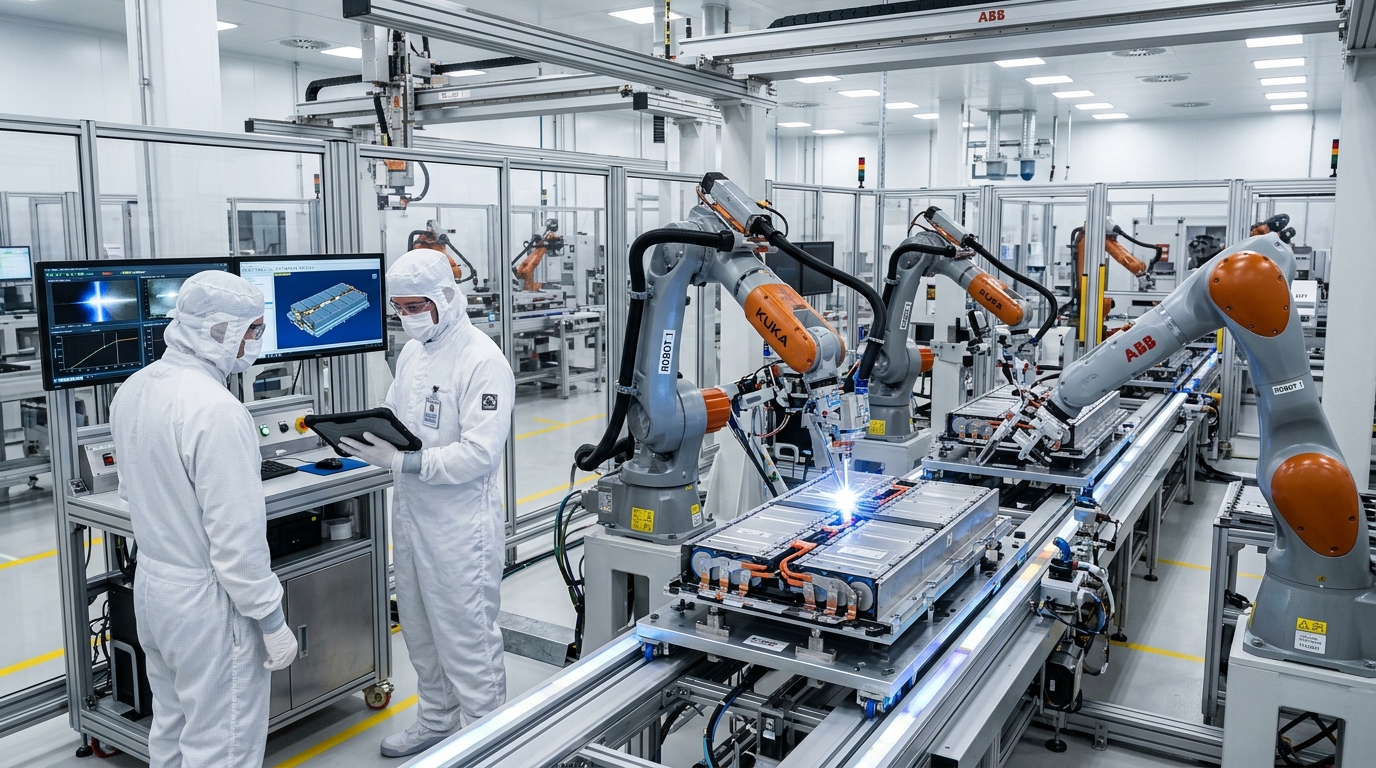
1. EV Powertrains & High-Voltage Architecture
Electric vehicles demand rigorous assembly standards for high-voltage battery enclosures, power electronics, and high-torque electric drive units.
Phase 1: High-Voltage & Battery Assembly Lexicon (6 Core Cards • 30 Spoken Sentences)
Master essential automotive engineering terminology. Click to hear native US pronunciation and practice aloud.
- "CTP design increases volumetric energy density by over 15%."
- "We use robotic laser welding to join the copper busbars."
- "Pre-load clamping force must be maintained during curing."
- "Prismatic cells are aligned to prevent micro-short circuits."
- "The bottom tray serves as a structural vehicle crossmember."
- "An open HVIL circuit triggers an immediate main contactor shutdown."
- "Ensure the Manual Service Disconnect is locked out before maintenance."
- "Dielectric insulation resistance must exceed 500 megaohms."
- "The pre-charge resistor limits inrush current to the DC bus capacitor."
- "Always verify zero voltage with an approved CAT-IV multimeter."
- "Cell balancing algorithms maintain delta voltage under ten millivolts."
- "Aerogel insulation blankets prevent cell-to-cell propagation."
- "The pyro-fuse disconnects the high-voltage bus in under two milliseconds."
- "Pressure relief valves safely vent off-gases during an overcharge test."
- "State of Health estimation is calibrated via Coulomb counting."
- "Automated dispensers apply gap filler with strict bead volume tolerance."
- "Thermal conductivity must reach at least two point five watts per meter kelvin."
- "We must eliminate trapped air voids to prevent localized hot spots."
- "Dielectric coolant channels utilize a fifty-fifty glycol-water mixture."
- "Cooling circuit flow rates are validated through differential pressure testing."
- "800-volt architecture halves current draw, reducing harness copper weight."
- "SiC MOSFETs achieve switching frequencies exceeding twenty kilohertz."
- "Hairpin stator winding increases slot fill factor up to seventy percent."
- "Regenerative braking transfers up to two hundred kilowatts back into the pack."
- "Dual-motor torque vectoring provides millisecond yaw control."
- "The HiPot test subjects the enclosure to two thousand volts DC for sixty seconds."
- "Leakage current must not exceed one hundred microamps during dielectric stress."
- "Helium sniffing confirms sealing compliance to IP69K ingress protection."
- "All fastener torques are recorded in the manufacturing traceability database."
- "The pack is flashed with production firmware before final chassis marriage."
Phase 2: High-Voltage Assembly Troubleshooting Studio
Practice reporting high-voltage assembly anomalies clearly and concisely using standard automotive engineering protocol.
Line Incident: "Busbar Laser Weld Spatter & Micro-Crack Alert"
"Station 40 reports excessive spatter on cell terminal twelve. We must halt the indexing conveyor, inspect laser optics for contamination, and perform ultrasonic weld depth verification."
Phase 3: Two-Way Technical Engineering Roleplay Simulator
Pair up! One participant takes Person A (Plant Quality Engineer) and the other takes Person B (Battery Systems Lead).
Phase 4: Real-World Automotive Case Studies & Engineering Scenarios
Analyze each manufacturing scenario and present your engineering resolution out loud in English:
Phase 5: EV Engineering Workshop Evaluation & Certification
Rate your mastery of high-voltage assembly terminology, technical precision, and conversational fluency: